
What Is Kanban and How Does It Improve Workflow? A Practical Guide for Teams
There are days when you shut down your computer feeling like you just ran a marathon, but when you look at your to-do list, it seems like you barely moved an inch.
Emergency meetings that interrupt your concentration, emails piling up in your inbox, high-priority tasks stuck "on hold" waiting for an approval that never comes, and that annoying voice in your head asking: "Why isn't anything flowing the way it should?"
If this sounds familiar, you are not alone, and you are not doing a bad job. What you are experiencing is the invisible exhaustion caused by multitasking and a lack of visibility into the work. The good news is that there is a way to regain control, focus, and a consistent delivery pace within your team without making drastic or disruptive changes.
That approach is called Kanban.
What Is Kanban and How Does It Help Your Team?
Kanban is a work philosophy and continuous improvement method based on visual management. Originally developed by Toyota, it makes work visible, limits work in progress (WIP), and manages workflow from request to delivery, reducing stress and accelerating value delivery.
The Lesson from the 1950s That Changed Human Productivity
During the 1950s, Toyota faced serious challenges on its production lines due to overproduction, delays, and errors. Taiichi Ohno, an industrial engineer at the company, was inspired by observing American supermarkets, where products were replenished on shelves in exactly the quantity and at the moment customers removed them.
Until then, factories operated by "pushing" work, accumulating inventory and creating massive bottlenecks. Ohno applied the supermarket logic to the production line and created the "Pull" system using small visual cards that indicated what to produce, when, and in what quantity: the Kanban system.
The same thing happens in modern offices: when we "push" dozens of projects onto people at the same time, we create bottlenecks. On the other hand, when the team pulls work only when it has the actual capacity to execute it, flow improves and delivery moves forward with greater clarity.
Method vs. Tool: The Common Mistake That Creates Frustration
Many teams try to solve disorder by opening a digital board with columns such as "To Do," "In Progress," and "Done." However, after a few weeks, the board becomes chaotic. Why does this happen?
The international KBFC standard points to a fundamental difference:
- The Tool: The visual board and cards, whether physical or digital, that allow the idea to be put into practice.
- The Method: The philosophy of continuous improvement and the way we think about work, based on changing progressively and respecting current processes.
A board without a method is simply a decorated task list. To achieve real transformation, you need to apply the 6 fundamental principles of Kanban:
- Start with what you do now: Do not change everything at once; respect your current processes, roles, and responsibilities to improve from your starting point.
- Visualize the work: Make everything you need to do visible so you can better understand the state of the project.
- Limit work in progress (WIP): Avoid multitasking and focus on finishing one activity before starting another.
- Manage the flow: Observe how tasks move through the process to identify and prevent blockers or bottlenecks.
- Foster leadership at all levels: Promote autonomy so every team member can suggest improvements and ideas.
- Continuous improvement (Kaizen): Continuously review and adjust your processes through small daily habits.
Practical Toolkit: Audit Your Team in 5 Phases
Want to diagnose the real state of your workflow today?
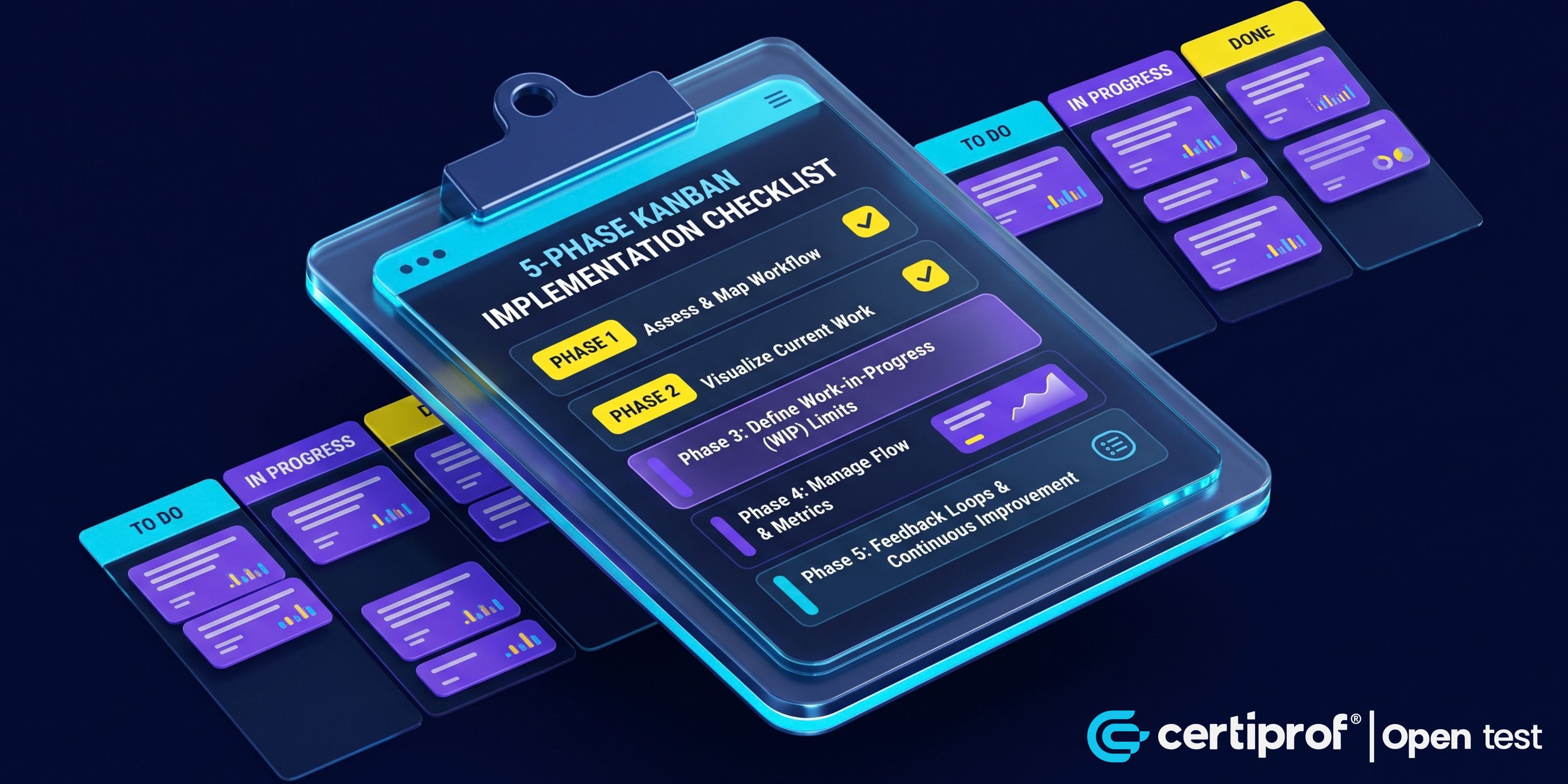
We created the Kanban Implementation Checklist (KBFC Standard) as an interactive PDF. A 2-page guide that is ideal for reviewing with your team during your next retrospective:
- Phase 1: Fundamentals & Mindset (Method vs. Tool).
- Phase 2: Board Setup & Effective Cards.
- Phase 3: WIP Control & Bottleneck Management.
- Phase 4: Key Performance Metrics (Lead/Cycle Time).
- Phase 5: Continuous Improvement (Kaizen) & KBFC Preparation.
Download the Kanban Implementation Checklist PDF for free here
After the Checklist: Turn What You Discover into Real Improvements
Downloading the checklist helps you identify opportunities, but the real value comes from what you do with that information.
Once you review the five phases with your team, use the results to start a concrete conversation:
Where Is Work Piling Up?
Look at where tasks stop moving forward. That point may reveal a bottleneck, dependency, or capacity limitation that is affecting the entire flow.
What Is Blocking the Work?
A pending approval, incomplete information, an external dependency, or too many open tasks can stop the flow for hours or even days.
Make these blockers visible and turn them into topics for team discussion.
What Can We Improve This Week?
You do not need to transform the entire system at once.
You can start with one small change:
- Reduce WIP.
- Make blocked tasks visible.
- Define more clearly when a task is truly complete.
- Review which meetings are actually adding value.
- Identify where unnecessary waiting is happening.
The goal is not to build a perfect system.
The goal is to create a system that learns and improves continuously.
Kanban Is Not About Doing More. It Is About Finishing Better.
In many teams, productivity is measured by the amount of work entering the system.
Kanban proposes changing the conversation.
That shift in perspective can transform how a team understands its work.
The Next Step: Take Kanban from Theory to Practice
If the checklist helped you identify opportunities for improvement, the next step is to deepen your understanding of the principles that help build a more visible, controlled, and sustainable workflow.
Make work visible. Limit what is in progress. Identify blockers. Improve the flow. And start finishing what really matters.